
Are we reinforcing the blame we’re trying to overcome?
 Emma Hargreaves / 9 November 2026
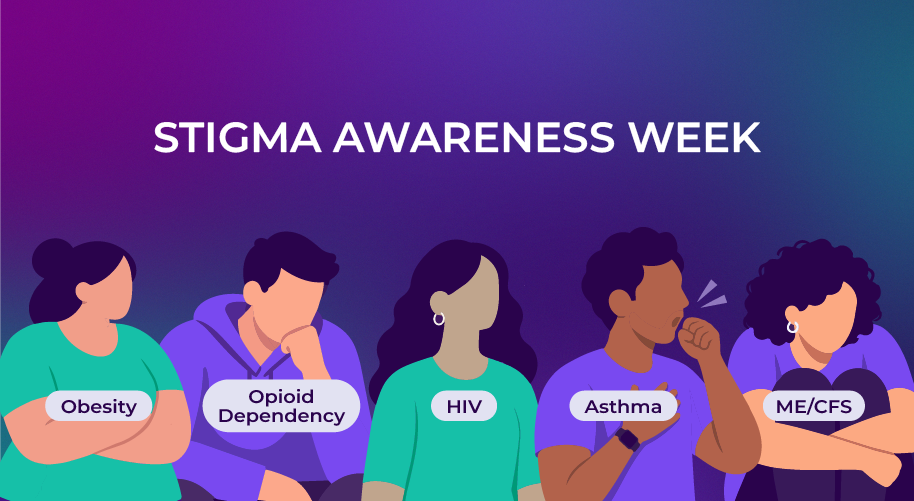
We are starting our Stigma Awareness Week with perhaps one of the most visible forms of stigma in healthcare: blame.
We now understand obesity as a complex chronic disease, shaped by interactions between biological, environmental, social and behavioral determinants.1 At the same time, GLP-1s and other therapeutic advances have transformed both the science and public conversation around its treatment.
Yet step outside the clinical conversation and another version of obesity remains remarkably noticeable: one of diets, quick fixes, supplements and promises of transformation. Even prescription weight-management medicines can become caught between these worlds, being understood as medical treatments by some, but as ‘weight-loss jabs’, lifestyle products and rapid solutions by others.
While the science increasingly tells us obesity is complex, chronic and deserving of evidence-based care, are the messages surrounding people living with it still telling them something much simpler: “eat less, move more; it’s your weight to fix”?¹
When weight is framed primarily as the consequence of individual choices, or weaknesses, responsibility can quickly become blame. And the person living with obesity can become responsible not only for managing the condition but also perceived as responsible for having it in the first place.
When responsibility becomes blame
Weight bias can characterize people living with obesity as lazy and lacking willpower or self-discipline, despite what we now understand about the multiple determinants of obesity.² These assumptions are not confined to social media or popular culture. They can enter workplaces, families and healthcare itself. WHO/Europe has specifically highlighted false perceptions among both the public and healthcare professionals (HCPs) as drivers of weight stigma. Evidence also suggests that weight bias among HCPs can influence clinical decision making and contribute to inequalities in care.³
Blame can also be embedded more subtly in the healthcare experience, from language that assumes weight is simply a matter of choice to conversations that attribute unrelated health concerns to weight or don’t facilitate meaningful discussions on possible connections to other conditions. Similarly, support can often start with “what have you tried?” rather than “what might be getting in the way?”. In this scenario, when treatment is discussed, will it really be experienced as healthcare, or as another judgement on your (in)ability to manage your own body?
And blame doesn’t motivate better health. Weight stigma has been associated with avoidance of healthcare, social withdrawal, disordered eating behaviors and poorer psychological and physical health. It can also become internalized, with people applying society’s negative assumptions about weight to themselves.⁴
The arrival of increasingly effective pharmacological options has changed what is medically possible. But it has also exposed an interesting contradiction in how obesity is perceived, with choosing treatment being judged as “the easy way out” or “cheating” or questioned with “why can’t they just do it themselves?”. The underlying assumption, here, is that weight is ultimately a test of personal responsibility (and by the way, you’re failing). It’s a painful irony: stigma in this context often intends to encourage personal responsibility but it can also create barriers to the very behaviors healthcare is trying to encourage.
We wouldn’t expect someone to learn to swim by making them ashamed of needing help in the water. Yet in obesity, shame can still be mistaken for encouraging motivation.
Are our communications challenging this blame, or inadvertently reinforcing it?
For anyone designing obesity communications, education, services or support, there is therefore a need to challenge ourselves on whether our designed interventions are tapping into, or reinforcing, these negative assumptions and connotations of blame.
Language matters. Imagery matters. The way treatment success and failure are framed matters. Even seemingly positive messages about taking control, making better choices or achieving transformation can carry assumptions about personal responsibility, if we haven’t understood how they will be experienced.
At PX+CX, we look beyond the science to understand the beliefs, behaviors and experiences that determine how that science lands in the real world.
Chronic care depends on people feeling able to take an active role in their health. But responsibility is not the same as blame. When blame changes how someone seeks support, engages with treatment or manages their health over time, it can undermine the very behaviors our interventions are designed to enable.
Where might blame be shaping the behaviors and experiences your obesity strategy is trying to change? Through Shared Health, PX+CX looks beyond the obvious to uncover what shapes patient and HCP experiences.
Talk to PX+CX about where stigma might be influencing your work or your outcomes, and where designing differently could.
References
¹World Obesity Federation. Obesity & its ROOTS. Accessed November 2026
²Brown A, et al. EClinicalMedicine. 2022;47:101408
³World Obesity Federation. Obesity & weight stigma. Accessed November 2026
⁴World Obesity Federation. Weight stigma. Accessed November 2026

View more Inizio Engage insights.
Jump to a slide with the slide dots.
 Emma Hargreaves
Where does stigma show up in healthcare, and what changes when we recognize it?
Inizio Engage XD explores how stigma shows up across healthcare, how it can influence patient and HCP behavior, and why recognizing it is essential..
Read more
 Jamie Pedlar
Recovery without judgement: are we there yet?
Explore how stigma, mistrust and judgement can shape opioid dependence treatment, patient engagement and recovery, and why trust must be part of the..
Read more