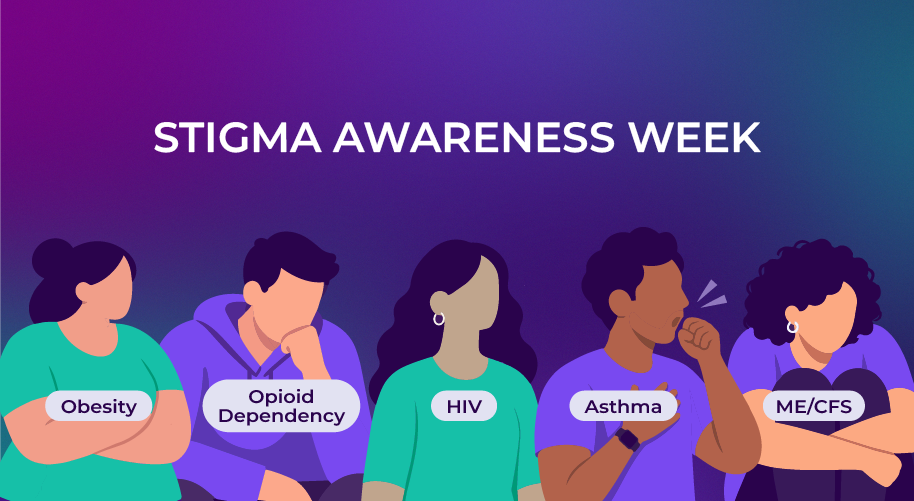

Throughout this week, we’ve focused on how stigma is placed onto patients in different ways, but what happens when we don’t challenge external stigma and it becomes internalized?
When you are diagnosed with a “hidden” chronic condition that can have a negative public opinion, such as ME (myalgic encephalomyelitis), these external opinions can leech into your own beliefs, leading to internalized doubt about your own condition and the real impact it has on your life. If we don’t challenge this, it can impact how a person engages with healthcare professionals (HCPs) or if they even continue to engage at all – “I barely have the energy to call up and book this appointment, why waste it?”
What happens when other people’s doubt becomes your own?
When you live with a condition other people can’t see, you can spend a surprising amount of time trying to prove that it’s there. I know, because I live with one.
After numerous appointments at the doctors, where I was consistently ill with flu, colds, painful headaches, severe fatigue and pain in my chest and had no real understanding of why I kept getting ill, I was pretty frustrated.
“It’s just ‘Fresher’s Flu’.”
“You do a Chemistry degree don’t you? Maybe it’s just the chemicals giving you a headache.”
“Just try and take it easy and rest.”
“Chest pain? Oh, it could be costochondritis; you can treat that with over-the-counter medicine or we can do an injection into your ribs?”– No, thank you.
Constantly being dismissed when you know that something isn’t right can start to sow the seeds of doubt: maybe I’m not that ill, maybe I’m overreacting, maybe it’s all in my head?
Arranging and attending appointments repeatedly began to feel like an uphill battle – prepare my notes, track all my symptoms, make sure I have a solid case to prove something isn’t right.
I told them my consistent illness didn’t feel like something a normal, healthy person would experience.
“Your blood tests have come back clear, so I don’t really know what I can do for you.”
Hearing this was an immense blow; it felt like the doctor thought I was overreacting and wasting their time. After so many appointments and so much energy spent, I was still no clearer on what was wrong.
In a position like this, advocating for your needs and communicating your experience to a HCP can be very difficult. All the while, the HCP probably has no idea of the preparation and energy I spent to get ready for this appointment, unaware of the mental load. This fueled the doubt and the internalized stigma: what was the point in booking another appointment if “there’s nothing wrong with me”? If the professionals don’t perceive me as ill, what’s the point of asking for their help?
I began to try and ignore my symptoms and became reluctant to seek medical help when I was feeling unwell. It felt like there was no point to it, I’d have to manage it alone. I didn’t receive any follow-up appointments or communications from my doctors, further solidifying my thoughts.
Without understanding and empathy of the hidden weight patients with chronic illnesses carry, support and communication between HCPs and patients can fall flat and sometimes cease altogether.
In the end, I turned to private healthcare to receive my diagnosis and now receive ongoing treatment.
How do we prevent external stigma becoming an internal barrier to care?
Pre-diagnosis, my frequent appointments were never addressed by my doctors, it felt as though they saw my illnesses as standalone. If they had tried to dig deeper into why I kept returning, asking if I felt there could be a link between my illnesses, empathized that it must be quite frustrating that I kept getting ill, I would have felt much more supported that there was a partnership between myself and the doctor – we’d figure out what was happening together, to get me the support I needed.
If I had been asked to keep a diary of any sickness and scheduled a follow-up appointment there and then, I wouldn’t have used more energy booking another appointment. The preparation for these future appointments would have felt purposeful, rather than a plea for understanding and approval.
When I’d started to give up, if I had been offered a follow-up appointment to check in on any improvements or any regression of my symptoms, it would have made me feel seen and encouraged.
Since I received a diagnosis, I still struggle with internalized stigma due to external experiences, although now more so from friends, family and others I interact with. There are a few interactions I still vividly remember that linger when I have self-doubt. For example, when I told someone about my condition and they misheard me, thinking I’d said ‘MS’. When I further explained it was ‘ME’, they said, “well that doesn’t sound as bad as MS, you’re lucky!” ME is also referred to as chronic fatigue syndrome (CFS), which doesn’t really capture the magnitude of the condition and its lived experience. When I explained to a friend that I finally had been diagnosed, they said, “what? So, you’re a bit tired? Maybe get more sleep?”
Although these may seem like small passing comments, they all add kindling to the fire of internalized stigma; they’re detrimental to your confidence, how you interact with friends and family, and in how you show up to your appointments. You may not mention a new symptom has appeared because it’s not that bad and you can deal with it – others have it worse than you.
To truly target internalized stigma, HCPs should listen to the words used to describe symptoms to understand if internalized stigma is causing underestimation of an experience – is there patient downplaying any aspect of their lived reality, such as “my headaches are worse but they’re not that bad, I can manage”, or “I was able to get out and do a small food shop, that’s better than other days!” They should ask if the symptoms impact you emotionally and mentally and validate your experience when you are struggling, encouraging you to speak about it and advocate for yourself. Explain that it doesn’t matter what other people experience, it’s about you.
Chronic care depends on self-management; it depends on people taking an active role in their health, and self-advocacy is part of this self-management.
If repeated stigma causes someone to distrust their own experience, feel unable to advocate for themselves, or withdraw from healthcare, it is undermining exactly the agency that chronic care requires.
Five conditions. Five very different experiences of stigma. Five reminders that stigma doesn’t always announce itself. It can lurk in the words we use, the assumptions we make, the environments we create and the systems people have to navigate.
That’s why we believe better health experiences start with understanding the perspectives we share, and the ones we don’t. At PX+CX, our Shared Health approach helps us bring those perspectives together, uncover the tensions and barriers between them, and design experiences that work better for everyone.
If stigma can look this different across five conditions, where might it be hiding in your patient or HCP experience?
Talk to PX+CX about where stigma might be influencing your work or your outcomes, and where designing differently could make a difference.