
What if stigma is hiding behind poor adherence?
 Preetam Virdee / 12 November 2026
Asthma seems like a straightforward disease to manage. If you feel short of breath, use your inhaler, feel better. Patients with asthma are taught to self-manage their condition, which can be challenging at times while you learn to control the disease. However, what happens when self-managing that condition means making it visible to others, and how can that societal perception impact the way in which a person self-manages?
As someone with asthma, I know first-hand what self-management of a condition feels like. From a very young age, I was taught about the signs and symptoms of asthma, how to monitor and manage my breathing, and how to know when to use my inhaler (with adult supervision at the time). Learning how to manage the symptoms and spot signs of an asthma attack certainly felt like a lot for me to remember and control, but as soon as the doctor was happy with my progression, they sent me on my way.
But what happens when doing exactly what you’ve been taught to do makes your condition visible to everyone around you?
The ability to self-manage a chronic condition is a very sensitive act and the experience of being seen managing it – and the responses to that – can be a barrier to adherence.
The societal view
A study conducted in 2020 found that a large majority of the surveyed patients with asthma (aged >18 years of age) had moderate levels of self-stigma and low self-esteem, both of which were more apparent in those with poor asthma management and control.¹ Another study conducted in the UK through Asthma UK’s online forum found that teenagers often felt embarrassed about having asthma and having to use an inhaler. This was due to negative reactions to their condition, such as mocking and social exclusion.²
The impact of this self- and social stigma can have differing levels of effect. However, one of the more concerning impacts is the one it can have on adherence. For patients with asthma, adherence to treatment and not being worried about how they are viewed for needing an inhaler can be the difference between breathing freely and a higher risk of a life-threatening asthma attack.²
The Asthma UK study reported that the rate of asthma attacks, hospitalizations and deaths were higher in teenagers than in children. However, the chance of an asthma attack is reduced when a person uses their preventer inhaler more than 80% of the time; teenage usage of an inhaler can be as low as 25-35%.² The question is, why might that be? The research outlined several potential barriers to teenagers using their inhalers, with negative portrayal of people with asthma on TV and in films being a top factor.² This portrayal and societal view – this stigma – may be a driver of the lack of inhaler usage by teenagers when they truly need it.
I have felt a level of that stigma. I remember in school during breaks, playing football with friends – they were more than happy to pass me the ball. But I took one rest to catch my breath and used my inhaler, something they all saw. Suddenly, I was being overlooked, told I can’t run far and sidelined.
Are we equipped to see stigma within non-adherence?
The very behavior that helps to protect someone’s health (using an inhaler during exercise, for example) can also be the one that exposes them to stigma (using said inhaler may result in their peers viewing them differently). Once someone with asthma has experienced a negative response when they are seen using their inhaler, the next time they need to use it, they’re possibly anticipating that negative response again and feeling self-conscious. To avoid those feelings and negative reactions, they may avoid using their inhaler in front of others, which in turn can result in poorer management (not using the inhaler when needed if they’re out with friends, for example).
Worryingly, one of the lead researchers for the Asthma UK study outlined that the idea of social and self-stigma was never an aspect that was discussed in their consultations with teenaged patients.² Therein lies the problem. If stigma is impacting patients, and healthcare professionals (HCPs) are only seeing the issue as non-adherence without discussing the reasons why, we are potentially missing the behavioral factor driving the non-adherence to begin with.
With the potential dangers that asthma attacks can bring, the impact stigma has on inhaler usage cannot be ignored or be missed during asthma management and treatment. It is not a case of HCPs not knowing asthma or how to get patients to self-manage their condition. The problem lies in the conversations with patients about condition management: the nuance around transition management, self-administration, and aging with the condition, and how the social reality of self-management is often not given enough time and support.
Overall, this isn’t just an adherence problem. Poor adherence is the outcome, the experience of the patient and the stigma they are facing is the problem.
Educating patients and HCPs may only address the issue on the surface. But tailoring that education, so that it highlights the true lived experience and embeds that nuance into broader discussions on asthma as a chronic condition, may push the conversations further. By supporting HCPs with understanding the stigma their patients could be facing, it puts them in a position to ask the questions that may better support their patient. Questions such as: where do you feel comfortable using your inhaler? How do your friends respond? Does using your inhaler make you feel different to others? What would make managing your asthma easier in those situations?
For someone with asthma, the very act of managing their condition can make it visible to others and potentially expose them to stigma. Through Shared Health, PX+CX explores the social and emotional realities behind treatment behaviors, helping patients and HCPs recognize barriers to effective self-management and identify where additional support could make a difference.
What if one of your apparent adherence challenges has a social or experiential barrier underneath it?
Talk to PX+CX about where stigma might be influencing your work, and where designing differently could make a difference.
References
¹Ahmad S, et al. Front Public Health. 2020;7:420
²Queen Mary University of London. Teenagers with asthma feel mocked for using their inhalers. Accessed November 2026

Weitere Einblicke
Jump to a slide with the slide dots.
 Emma Hargreaves
Where does stigma show up in healthcare, and what changes when we recognize it?
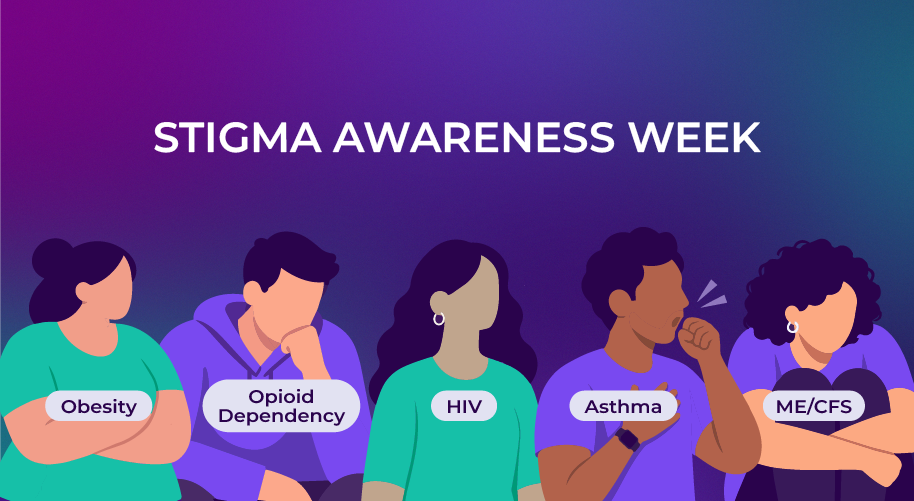
Inizio Engage XD explores how stigma shows up across healthcare, how it can influence patient and HCP behavior, and why recognizing it is essential..
Weiterlesen Emma Hargreaves
Are we reinforcing the blame we’re trying to overcome?
Explore how obesity stigma and weight bias can shape healthcare experiences, treatment engagement and patient behavior, and why communications...
Weiterlesen
 Jamie Pedlar
Recovery without judgement: are we there yet?
Explore how stigma, mistrust and judgement can shape opioid dependence treatment, patient engagement and recovery, and why trust must be part of the..
Weiterlesen
 Kate Higgins
If we ignore stigma, are we really communicating effectively in HIV?
Explore how HIV stigma can shape healthcare experiences, trust, treatment engagement and communication, and why addressing social narratives is...
Weiterlesen