
Recovery without judgement: are we there yet?
 Jamie Pedlar / 10 November 2026
Yesterday, we explored what happens when perceived responsibility becomes blame. Today, we go a step further: what happens when assumptions about a condition become judgements about the person experiencing it, and even the treatment they receive?
For many conditions, healthcare begins with an assumption of trust.
Yet for people living with opioid dependence, the experience is vastly different.
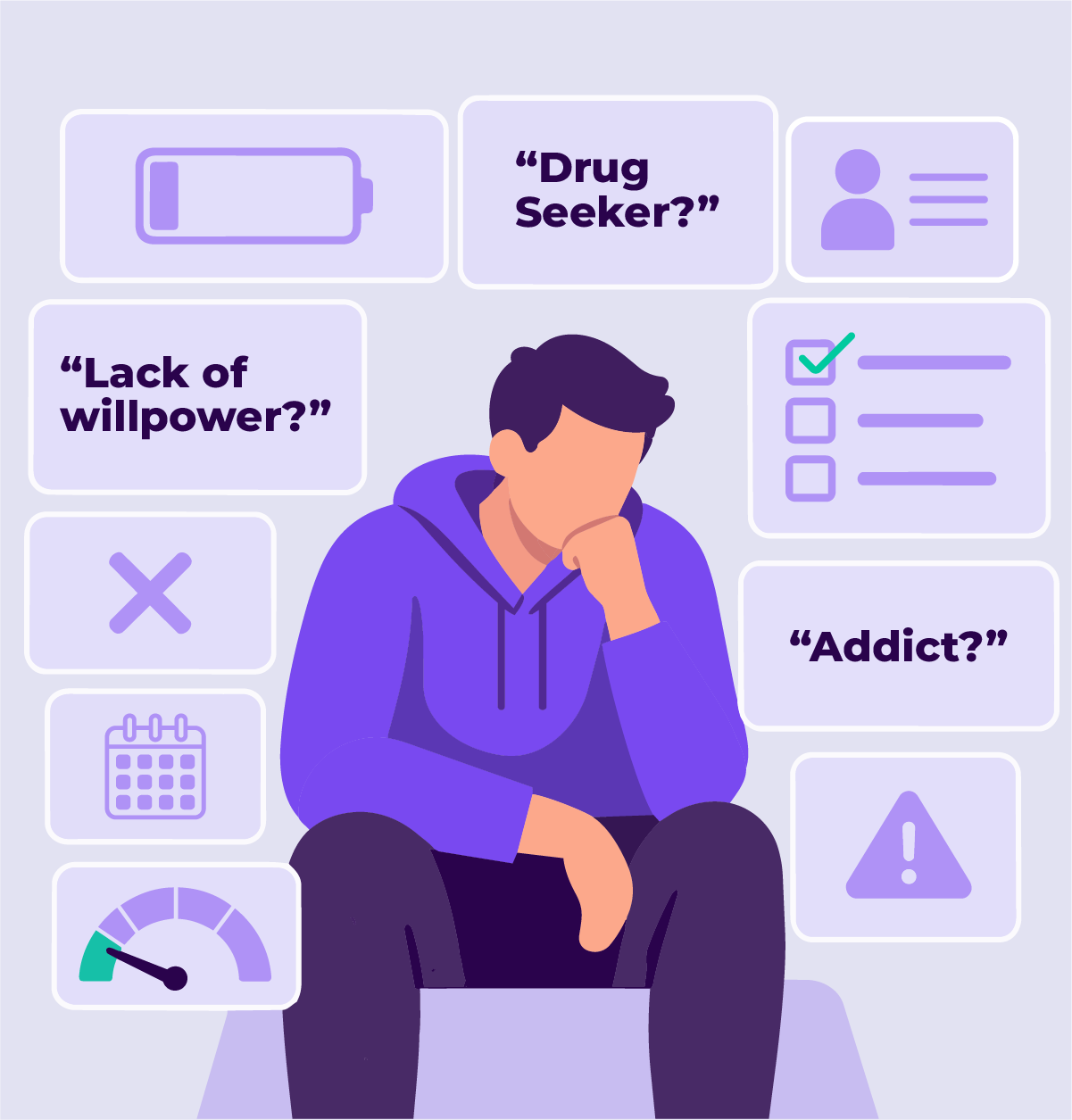
Opioid dependence doesn’t have one beginning, or one kind of person. It can develop against a background of trauma, psychological distress or complex life circumstances, with individual experiences and pathways into dependence varying considerably.¹ Different experiences, different routes into dependence, yet society can be remarkably quick to reduce these patients to the same assumption: that somewhere along the way, they made the wrong choices.
These assumptions don’t necessarily stop at the clinic door, either. Despite broad recognition that opioid dependence is a chronic medical condition, many patients still encounter systems, policies and attitudes shaped by suspicion rather than support. The National Institute on Drug Abuse (NIDA) notes that substance dependence continues to be viewed by many as a moral failing rather than a treatable health condition, contributing to patients experiencing discrimination and barriers to care.²
In some conversations more broadly, medications used to support those with opioid dependence are framed not as treatment options, but as methods to replace one dependency with another. For some people, recovery can be viewed through a moral lens that values abstinence above all else, regardless of what the evidence may say about effective care. The implicit message can become: if you’re still taking medication, are you really recovering or changing your behaviors?
Treatment can, therefore, carry its own stigma. But judgement isn’t confined to treatment decisions alone. It can be felt in the waiting room, at the reception desk, in the tone of a question or the reaction to a missed appointment. Inexperience in supporting patients with opioid dependent, or misconceptions about medication-assisted treatment, can create additional hidden barriers within the healthcare system itself.³ For someone who may already anticipate being seen as unreliable, difficult or undeserving, each ordinary healthcare interaction can become another moment in which they feel they must prove themselves.
Imagine approaching every appointment wondering whether you’ll be treated as someone who needs help, or someone who needs to earn it. Qualitative research suggests that while effective opioid-dependence treatment can restore patient stability and agency, some patients can simultaneously experience aspects of treatment as surveillance, restriction, or an indication that they are not trusted, with concerns around their substance use often introduced alongside well-intentioned attempts at effective care.⁴,⁵
For people living with both opioid dependence and mental health difficulties, accessing support can become a catch-22. Mental health services may expect a person’s substance use to be addressed first, while addiction services may struggle to support complex mental health needs. Both conditions require specialized care, yet the patient can find themselves caught between services, unable to meet the requirements of either, or access to the support they need.
This is precisely the challenge recognized in England’s 2025 Co-occurring mental health and substance use framework⁶, which calls for a “no wrong door” approach. When a person lives with a stigmatized condition, fragmented systems can compound an experience of being seen as difficult, unwanted or someone else’s responsibility.
The emotional impact can be significant. When someone begins to question whether they deserve support, asking for it becomes harder still.
So, what if one of the biggest barriers to treatment isn’t awareness or access, but the experience surrounding it?
We can develop robust clinical evidence, education programs and support services around opioid-dependence treatment. But ‘recovery’ is an inherently human concept. It recognizes that change takes time; that people may need safety, stability, support and the opportunity to move forward. Yet people entering treatment for opioid dependence can encounter an environment in which trust feels conditional on demonstrating the very stability they’re hoping to build. Perhaps the question isn’t simply about whether someone is committed to recovery, it’s whether we’re creating the conditions in which recovery feels possible.
If people feel judged for receiving treatment, and disempowered to believe they deserve it, then the experience surrounding treatment may undermine their engagement before any interventions or communications have had the opportunity to succeed.
The same applies to healthcare professionals (HCPs). If stigma, assumptions or unconscious biases are influencing behavior, providing more information will not be enough. Understanding the experience around treatment becomes just as important as understanding the treatment itself.
For PX+CX, this means asking different questions: where in the treatment journey are patients being asked to earn trust rather than receive support? Where is trust being built? How do patients experience conversations about opioid dependence? What assumptions are shaping HCP interactions? What language is helping or harming engagement?
Recovery needs more than effective treatment; it needs an environment of trust. Through Shared Health, PX+CX explores how judgement and mistrust can shape the experience of patients and HCPs, and where we could design differently.
Where might judgement or mistrust be undermining the treatment experience you’re trying to improve?
Talk to PX+CX about where stigma might be influencing your work or your outcomes, and where designing differently could make a difference.
References
¹Regmi S, et al., Trauma Violence Abuse. 2024 Jul;25(3):2046-2064
²National Institute on Drug Abuse. Stigma and discrimination. Accessed November 2026
³Klusaritz H, et al. Ann Fam Med. 2023;21(Suppl 2):S31-S38
⁴Couch JV, et al. Harm Reduct J. 2024;21:125
⁵Techau A, et al. J Addict Nurs. 2023;34(3):E119-E134
⁶GOV.UK. Co-occurring mental health and substance use delivery framework. Published 10 December 2025. Accessed November 2026
Weitere Einblicke
Jump to a slide with the slide dots.
 Emma Hargreaves
Where does stigma show up in healthcare, and what changes when we recognize it?
Inizio Engage XD explores how stigma shows up across healthcare, how it can influence patient and HCP behavior, and why recognizing it is essential..
Weiterlesen Emma Hargreaves
Are we reinforcing the blame we’re trying to overcome?
Explore how obesity stigma and weight bias can shape healthcare experiences, treatment engagement and patient behavior, and why communications...
Weiterlesen