
A global patient support programme blueprint has been designed and approved. The patient journey is mapped, the support services are defined and the overall model is agreed.
But how does that blueprint become a programme that can actually launch across multiple countries?
Healthcare systems, regulations, referral pathways and operational requirements differ from market to market. Before the first patient can enrol, the global model needs to be translated into something that works locally, while preserving the consistency and intent of the programme. That is where implementation planning begins.
As a European Implementation Manager, this is where I spend much of my time: working through the practical detail that turns an approved programme into an operational one.
The patient journey may already be defined. Our job is to build the operational journey behind it.
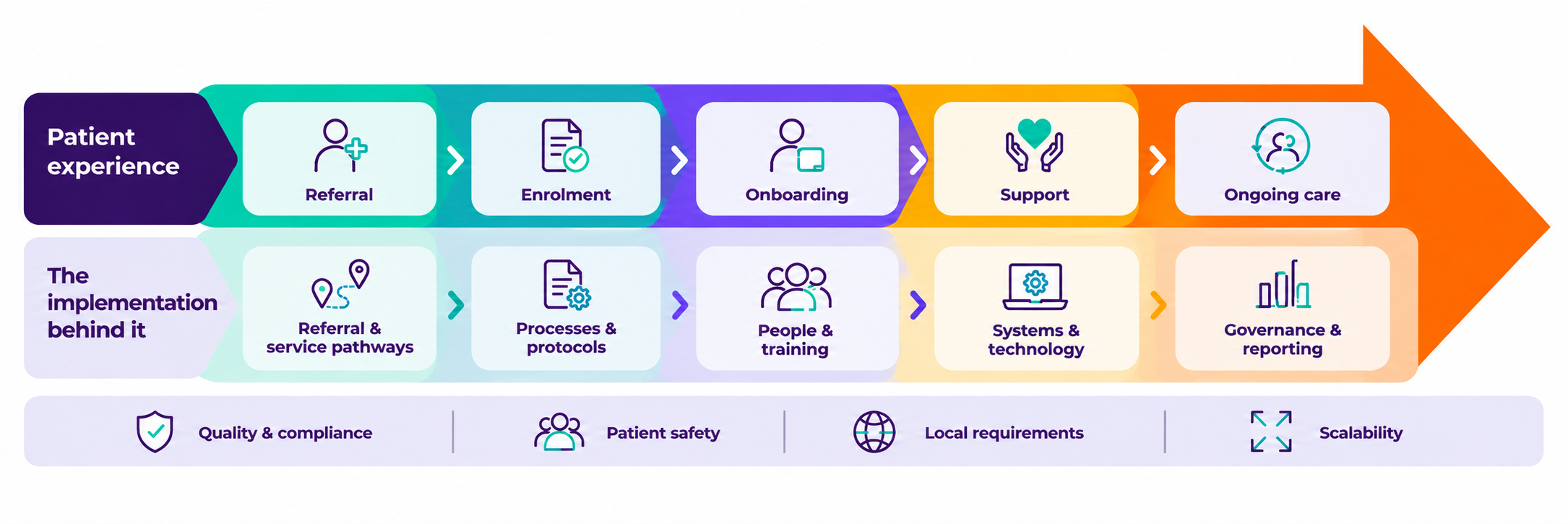
The first question is often: what needs to stay the same, and what needs to change?
A global PSP may provide a common framework for the patient journey and services, but the way it operates can look quite different from one European market to another.
Referral routes, healthcare workflows, regulatory requirements, available resources and patient preferences all need to be considered. Our role is to identify where local adaptation is needed while protecting the consistency, quality and intent of the overall programme.
That means working through how patients are referred, who is responsible for each step, what information needs to be captured and how each service will work within the local healthcare environment.
From there, we get into the detail.
We work through what needs to happen at each stage.
- How is an eligible patient referred?
- Who receives that referral?
- How is consent managed?
- What information needs to be documented following an interaction?
If the programme includes nurse-led or home-based support, there is another level of practical detail to consider.
- When is the patient introduced to the nurse?
- Will support take place in the home, remotely, or across both?
- What information does the nurse need before the first interaction?
- If a therapy involves a device, what training is required before the team can support patients safely and confidently?
We also need to plan for the situations that don’t follow the expected path.
- What happens if a patient needs additional support?
- How is a safety event identified and escalated?
- Who needs to be informed, and within what timeframe?
Answering those questions means bringing the right people into the conversation early. Clinical, operations, quality, technology and project teams each see the programme through a different lens.
A large part of my role is connecting those perspectives, identifying dependencies and making sure a process that looks straightforward on paper will work for the people actually using it, from the HCP making a referral to the team supporting the patient.
A change to the referral pathway might affect what we need to capture and report. Introducing home visits has implications for nurse resourcing, scheduling, training and potentially logistics. A technology decision can change how teams document patient interactions and what training they need.
So we continually ask a very practical question: if we change something here, what does it affect elsewhere? Working through those dependencies early helps us build one connected service rather than a collection of individual components.
Getting to launch is an important milestone, but implementation planning shouldn’t only focus on day one.
Before go-live, the nurses, clinical educators and other teams delivering the programme need to understand their roles and be fully trained. Referral and escalation pathways need to be clear, systems ready, and governance and reporting in place.
At the same time, a model that works for the first 50 patients needs to be able to evolve as volumes increase, services change or additional markets are introduced. Building in that flexibility from the beginning makes it easier to scale and optimise the programme as we learn from real-world delivery.
Ultimately, good implementation should make a complex programme feel simple.
Patients don’t need to see the processes, systems and planning behind their support. They need to know what happens next, who they can turn to and that the support will be there when they need it.
For me, that’s what successful implementation looks like. Much of the work happens before the first patient enrols, but its impact is felt in every interaction that follows.
Ver más información de Inizio Engage.
Jump to a slide with the slide dots.

Targeted CVD Patient Identification and Guideline-Aligned Therapy Optimisation
CASE STUDY (UK) Discover how Inizio Engage partnered with UK primary care to identify high-risk CVD patients, enable guideline-aligned therapy...
Leer más
 Caroline McGlynn
Transforming Healthcare: The role of a strategic outsourcing partner in delivering flexible, patient-led nursing services
Discover how Patient Solutions providers support the NHS Long Term Plan by delivering flexible, nurse-led care in community and home settings...
Leer más
Inizio Unveils Next-Generation Hub Services at Asembia 2026, Setting a New Standard in Patient Access
Inizio launches next-generation patient access Hub Services at Asembia 2026, combining analytics, pharmacy, and expertise to improve access and...
Leer más
The talent behind the talent: Christine Magnusson
Discover insights into patient support programs, patient-centred care, and healthcare solutions from Inizio Engage’s Christine Magnusson.
Leer más
Building a scalable Patient Support Program blueprint for international markets
See how Inizio Engage translated patient journey insights into a practical, scalable Patient Support Program blueprint designed for international...
Leer más